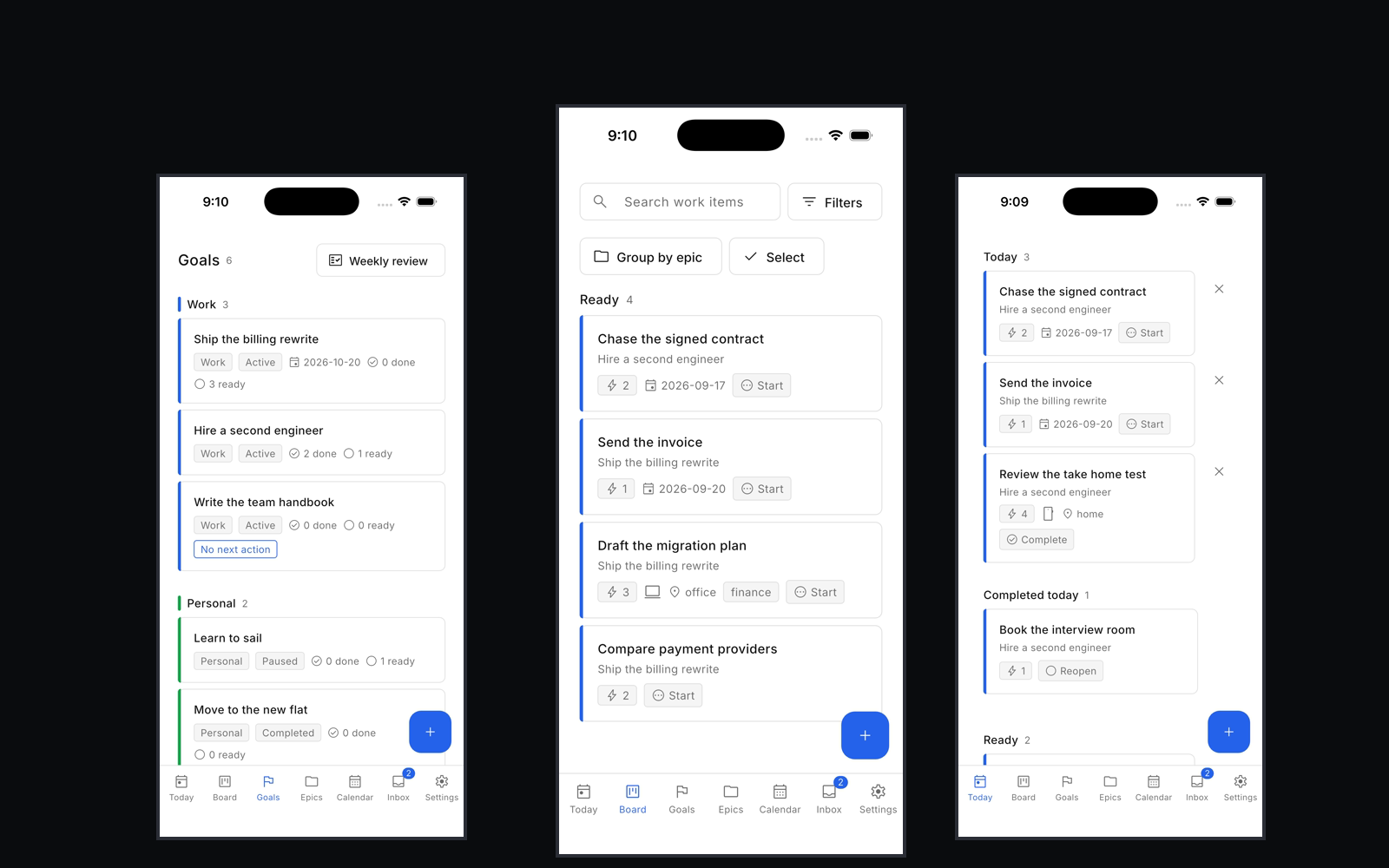
The goal with no next action
Most lists do not fail because they are too long. They fail because somewhere in them sits an outcome nobody has decided how to start, and a list cannot tell you which one it is.
The Outstanding Today team, on building the thing · 20 September 2026
There is a particular kind of stuck that does not look like being stuck.
The list is full. Things are being crossed off. Every week something ships. And yet one of the four or five outcomes that actually matter has not moved in two months, and nobody has noticed, because nothing about a full list draws attention to the one row that has gone quiet.
This is the failure GTD is built to catch, and it is worth being precise about what it is. It is not procrastination. It is not a priority problem. It is that somewhere between what I want and what I do on Tuesday there is a gap nobody has crossed, and the list has no way to show you a gap.
You can't do a project. You can only do an action related to it.
The shape
Three levels, and the gap between two of them
Outstanding Today has exactly three levels, and refuses to add a fourth. An epic groups things: Work, Health, a particular client. A goal is an outcome you want, achievable in about a year. A work item is one concrete action you could start on Tuesday.
The gap is always in the same place. Not between epic and goal, which is only filing. It is between the goal and the first work item, and it opens because deciding the next action is genuinely harder than writing the goal down. "Rewrite the billing system" takes four seconds. "Read the current invoice generator and write down what it actually does" takes a decision about where to start, which is the work you were avoiding.
So the goals view does one thing before anything else. Each goal shows how many work items are done and how many are ready to start.
Read down that column and the quiet goal announces itself. Write the team handbook. 0 done, 0 ready. It has been there since June. Nothing is wrong with it. It has no way in, and a list of goal titles would have shown it sitting there looking exactly as healthy as the rest.
The board is the counterweight. A work item reaches it only when it belongs to a goal, that goal is active, and the item is not archived.
That sounds like a restriction. It is the point. A board that shows everything you might one day do is a board you stop reading. This one shows what you have committed to, which means an empty column is information rather than an embarrassment.
And today is the narrow end. What is in progress, what is due today or was due earlier, overdue first, and underneath it everything ready to be pulled in.
Three views, three questions. What do I want. What have I committed to. What am I doing now. The goal with no next action fails the second question while passing the first, which is precisely why it survives in a flat list.
The habit
The review is the part that works
None of this helps if nobody looks. The structure makes the gap visible. It does not make anyone walk past it.
So the review is a mode rather than a suggestion. It walks every goal, epic by epic, and asks three questions about each one: is this outcome still what you want, is there a next action, and should this be active, paused or completed.
The third question is the one people skip, and it is the one that does the work. Most stuck goals are not stuck. They are goals you no longer want and have not admitted it, and the honest move is to pause them. A paused goal keeps every work item, leaves the board, and stops counting against your limit. It costs nothing and it is not a failure. It is the difference between a list you trust and a list you have started to skim.
A goal you are not working on is fine. A goal you are not working on and have not admitted you are not working on is the thing that quietly rots a system.
The constraint
Five is not a pricing decision
The Free plan allows five active goals at once, which is fewer than most tools allow and fewer than most people first want.
It is a real constraint, and we mean it as one. Five outcomes is roughly what a person can genuinely move in parallel. Past that you are not doing more, you are distributing the same attention more thinly and calling it ambition. The limit counts only active goals, so pausing is always allowed and never loses anything, which means the constraint can always be satisfied honestly.
Inviting someone who creates an account earns one more, to ten. Past ten, Pro removes the limit for ten dollars a year, because at some point we would rather charge you than pretend the number was ever about your storage.
The claim
What this actually buys you
Not productivity. Nothing here makes anyone faster.
What it buys is a shorter interval between a goal going quiet and you finding out. In a flat list that interval is however long it takes for someone to ask. Here it is one line in a weekly review, and the line reads 0 ready.
That is a smaller promise than most task managers make. It is also one the software can actually keep.